The Rise of Simple Syntax
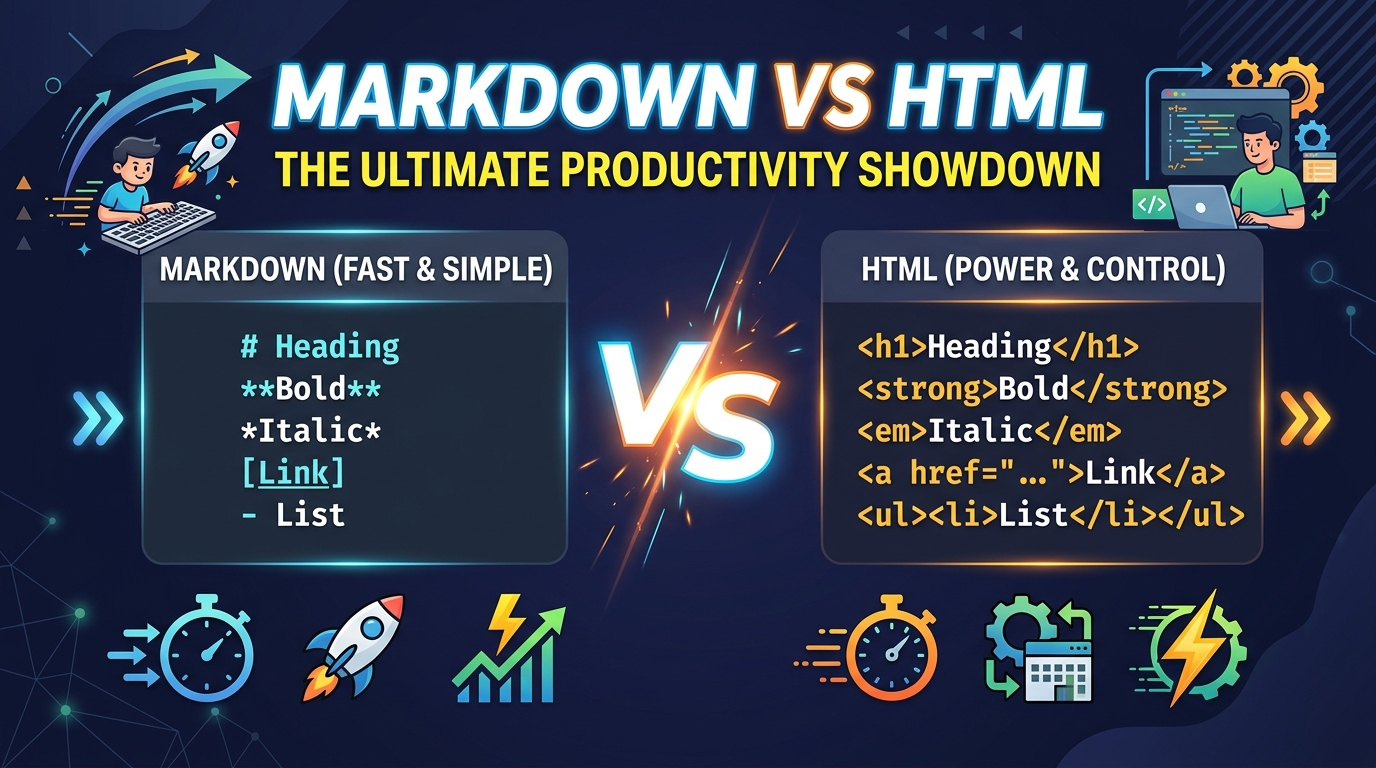
In the early days of the web, if you wanted to bold a word, you had to wrap it in `<strong>` tags. It was slow, distracted you from your creative flow, and made the raw file hard to read. Then came John Gruber's Markdown in 2004, and the writing landscape changed forever.
Markdown is a 'markup language' that uses simple plain-text symbols—like `#` for headings and `**` for bold—which are easily readable by humans and instantly convertible into valid HTML by computers. In 2026, it is the backbone of platforms like GitHub, Reddit, Notion, and Discord.
Why Markdown Wins for Creators
The biggest advantage of Markdown is 'Distraction-Free Writing.' When you write in HTML, you are thinking like a coder. When you write in Markdown, you are thinking like a writer. You don't have to worry about closing tags or nesting elements correctly; you just focus on the narrative.
Additionally, Markdown is 'Future-Proof.' Because it is just plain text, your Markdown files can be opened by any computer, 50 years from now, even if every modern software company has gone out of business. It is the ultimate insurance policy for your intellectual property.
The Role of HTML in 2026
Does this mean HTML is dead? Absolutely not. HTML is the 'skeleton' of the entire internet. While Markdown is great for 'content,' HTML is required for 'structure' and 'interactivity.' If you want a complex multi-column layout, a dynamic form, or an embedded video player, you still need to reach for HTML.
The most efficient modern workflow involves writing content in Markdown and then using a converter to generate the clean, semantic HTML required for your website's CMS or static site generator.
Common Conversion Pitfalls
When shifting from Markdown to HTML, be careful with 'Nested Lists' and 'Code Blocks.' Not all converters follow the same 'flavor' (e.g., GFM vs MultiMarkdown). Always validate your generated HTML to ensure your search engine can index it correctly.
Using a local tool for this conversion is far safer than using a random online site, as your content stays in your browser's memory and is never uploaded to a third-party server.
Practical Tips for Success
Start using Markdown for your personal notes today. Once you get used to the speed of typing a few hashes instead of hunting for a formatting button, you'll never go back. It's the single fastest way to increase your content output without working harder.