SEO: The Foundation That Still Matters
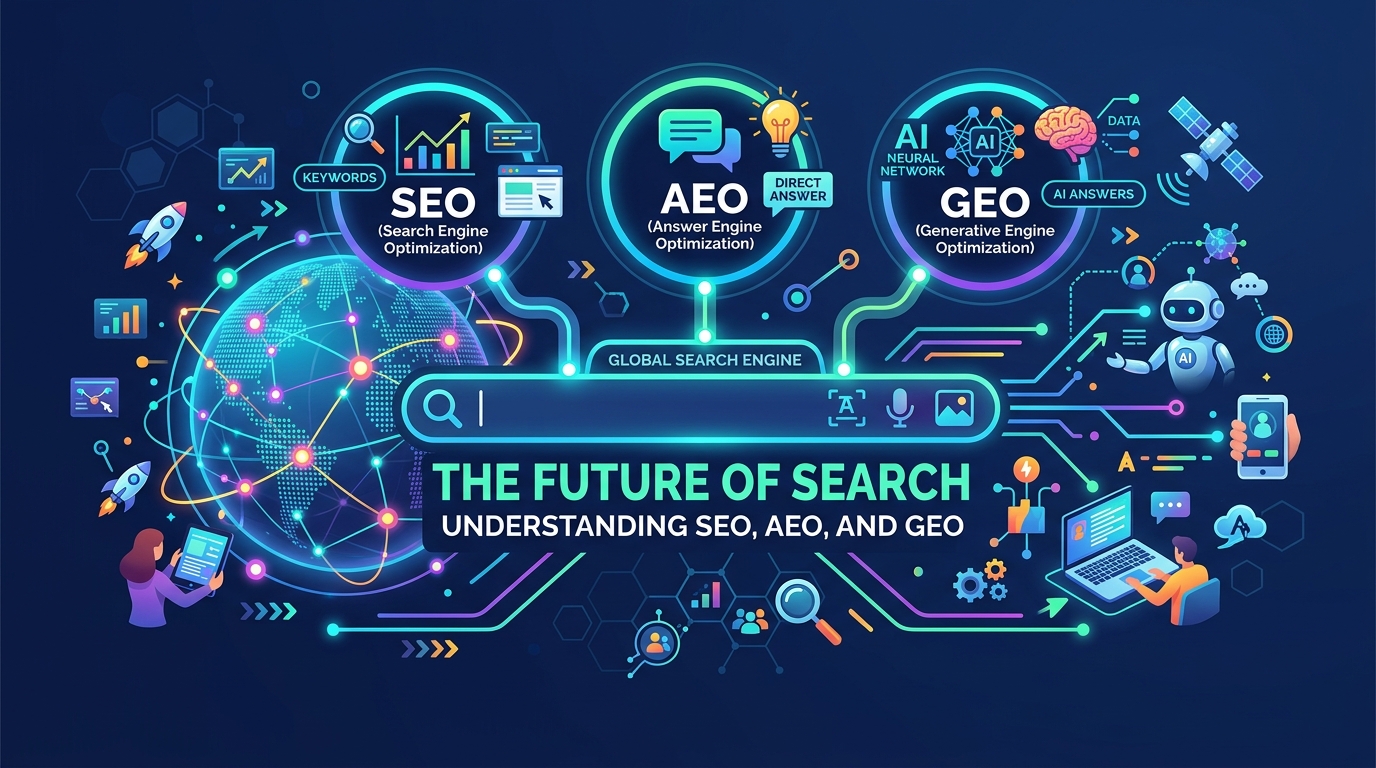
Search Engine Optimization (SEO) has been the cornerstone of digital marketing for decades. It focuses on optimizing your website to rank higher in traditional search results like Google and Bing by targeting keywords, building high-quality backlinks, and ensuring a flawless user experience.
In 2026, SEO is not dead, but it has evolved. Search engines are smarter than ever, utilizing advanced machine learning models to understand user intent rather than just matching keywords. This means that technical SEO, mobile-first indexing, and Core Web Vitals (like page load speed and layout stability) are now table stakes.
To succeed in traditional SEO today, you need to create deep, comprehensive content that covers a topic from all angles. Thin content is actively penalized. You need to prove to search engines that your page is the definitive resource on the subject.
AEO: Answering the User Directly in the Age of Voice
Answer Engine Optimization (AEO) is about optimizing content to appear in direct answers. This includes Google's Featured Snippets (Position Zero), voice assistants like Siri and Alexa, and the quick answer boxes at the top of search results.
With the proliferation of mobile devices and smart speakers, more people are asking questions in a conversational tone. Instead of typing 'best text tools,' a user might ask, 'What is the best free online word counter that respects my privacy?'
To win at AEO, your content must be structured to answer these specific questions directly and concisely. The 'Answer-First' approach is critical: state the answer clearly in the first 1-2 sentences, and then follow up with supporting details and context.
How to Use AEO on Your Website (With Examples)
The best way to optimize for AEO is to use clear formatting and structured data in your site's code. Here is how you can implement it:
1. Use Question Headings: Structure your content with headings that ask direct questions. For example, instead of a heading that says 'Word Count Limits', use 'What are the character limits for social media posts?' followed by a direct answer.
2. Implement FAQ Schema: Use JSON-LD FAQ schema to tell search engines explicitly what questions you are answering. This increases the chance of your content being pulled into rich snippets.
Example of a simple answer structure that works well for both users and AI:
Question: How do I calculate reading time?
Answer: You can calculate reading time by dividing the total word count by the average reading speed (usually 200-250 words per minute).
GEO: Optimizing for Generative AI Models
Generative Engine Optimization (GEO) is the newest frontier in search. It involves optimizing your content so that Generative AI models (like ChatGPT, Gemini, Perplexity, and Claude) cite and include your site in their generated responses.
AI models don't just search for links; they synthesize information from multiple sources to provide a comprehensive answer. If your site provides the most authoritative, clear, and well-structured data on a topic, the AI is more likely to use your content as a source and cite your link.
GEO relies heavily on data veracity and structure. AI models are trained to avoid hallucinations and look for verifiable facts. Citing sources, providing data tables, and using clear, unambiguous language helps AI models trust your content.
How to Use GEO on Your Website (With Examples)
Optimizing for AI requires a slightly different approach than optimizing for humans or traditional search engines. Here are concrete ways to optimize for GEO using plain text and clear data:
1. Create an llms.txt File: This is an emerging standard. By placing a structured text file at the root of your site (e.g., /llms.txt), you provide a clean summary of your site's content and API endpoints that AI crawlers can easily ingest.
2. Provide Raw Data and Lists: AI models love structured data. If you have a blog post about reading speeds, don't just write paragraphs. Include a clear list of data. AI models can easily parse this data and use it in their summaries.
Example of data that AI models can easily digest:
Audience: Children | Average WPM: 100 - 150 | Content Type: Fiction
Audience: Adults | Average WPM: 200 - 250 | Content Type: General Non-Fiction
Audience: Technical | Average WPM: 150 - 200 | Content Type: Documentation
Summary: The Holistic Search Strategy
You can no longer afford to ignore any of these three pillars. Use SEO to build your foundation and authority, AEO to capture quick answers and voice searches, and GEO to ensure your brand is cited by the AI models of the future.
TextToolsStudio provides the utilities you need to analyze your text, check keyword density, and ensure your content is structured perfectly for both humans and machines.