
The Universal Language of Modern Data
JSON (JavaScript Object Notation) has won the battle for the most popular data interchange format on the web today. It is lightweight, text-based, and easy for both humans and machines to parse. From REST APIs and GraphQL to local configuration files (like package.json), it is genuinely everywhere.
However, to save on bandwidth and improve server response times, production systems almost always 'minify' their JSON output. Minification removes every unnecessary space, tab, and newline character. While this is great for computers, it makes the data completely unprintable and unreadable for a human developer who needs to troubleshoot an issue.
Restoring Visual Hierarchy for Debugging
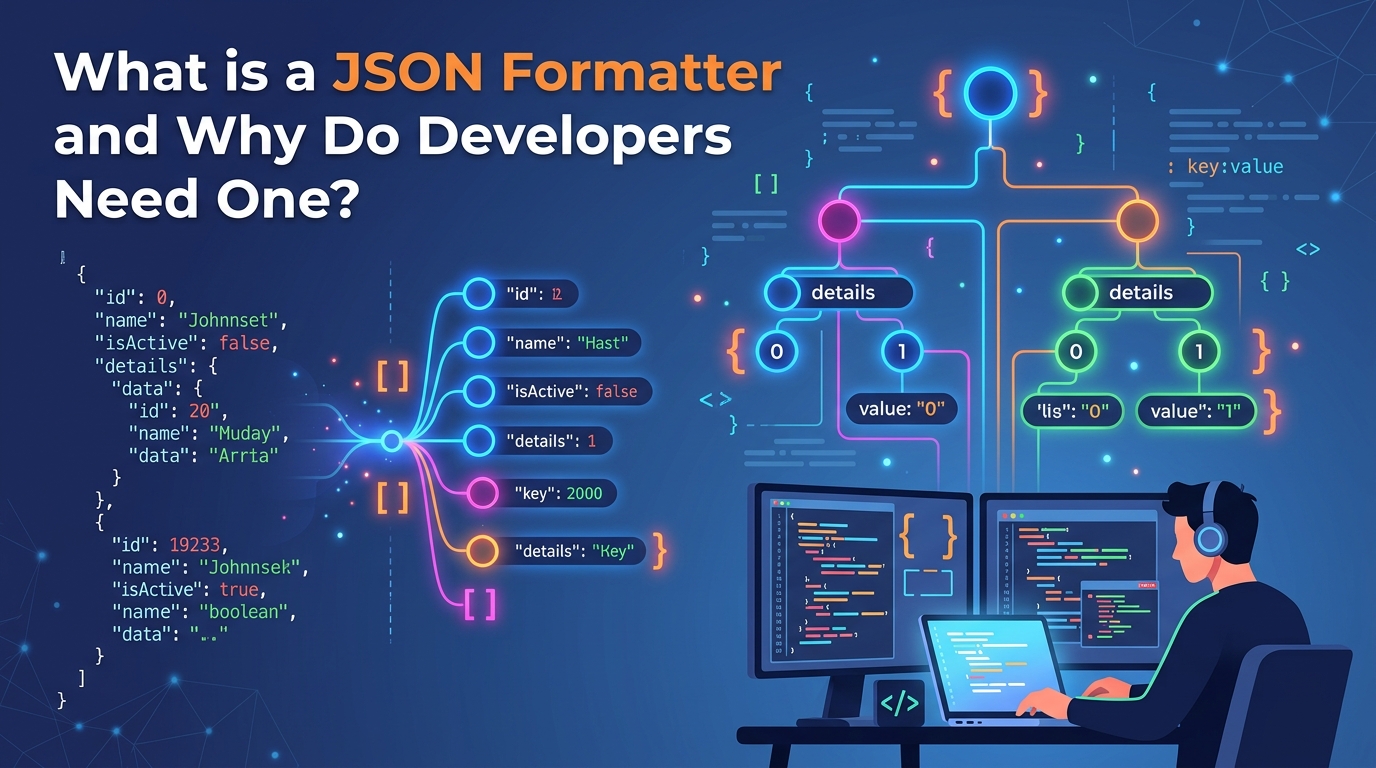
A JSON Formatter (often called a 'pretty-printer') restores the visual hierarchy to the raw data. By adding indentation levels, the tool allows a developer to instantly see the relationship between keys and values.
This is particularly crucial for complex, nested data structures where an array might be buried four or five levels deep inside various objects. Without formatting, you are hunting for a needle in a digital haystack. With a formatter, you are looking at a clear, structured map of your data architecture.
Validation: The Hidden Power of the Formatter
A single missing comma, a mismatched curly brace, or a misplaced quote will cause a JSON parser to throw an error. In many development environments, this results in the dreaded 'Internal Server Error' or a silent failure that is incredibly difficult to track down.
A high-quality formatter doesn't just make the text look good; it runs a live validation check. Our tool will point you to the exact line and character where the syntax error occurred, allowing you to fix it in seconds and get back to coding. This is the ultimate time-saver for anyone working with raw API responses.
Local Security vs. Cloud Exposure
In our experience, many developers casually paste sensitive company data—including user passwords, private API keys, or financial records—into random online formatting websites. This is a significant security risk, as that data is often processed and stored on third-party servers.
At TextToolsStudio, we prioritize security. Our JSON formatter runs entirely in your browser's memory. Your proprietary data never touches our server and is never stored in a database. This 'Local-First' approach makes it a secure, compliant solution for professional development teams working under strict privacy guidelines.
Integrating Formatters into Your Daily Routine
Whether you are a senior full-stack engineer or a student learning their first API calls, a dedicated JSON formatter should be in your browser's toolbar. It's the first tool you reach for when a fetch request goes wrong, and the last tool you use to verify your config files before a major deployment.
Don't let messy data slow down your innovation. Use a tool that provides the clarity you need to build faster and more reliably.