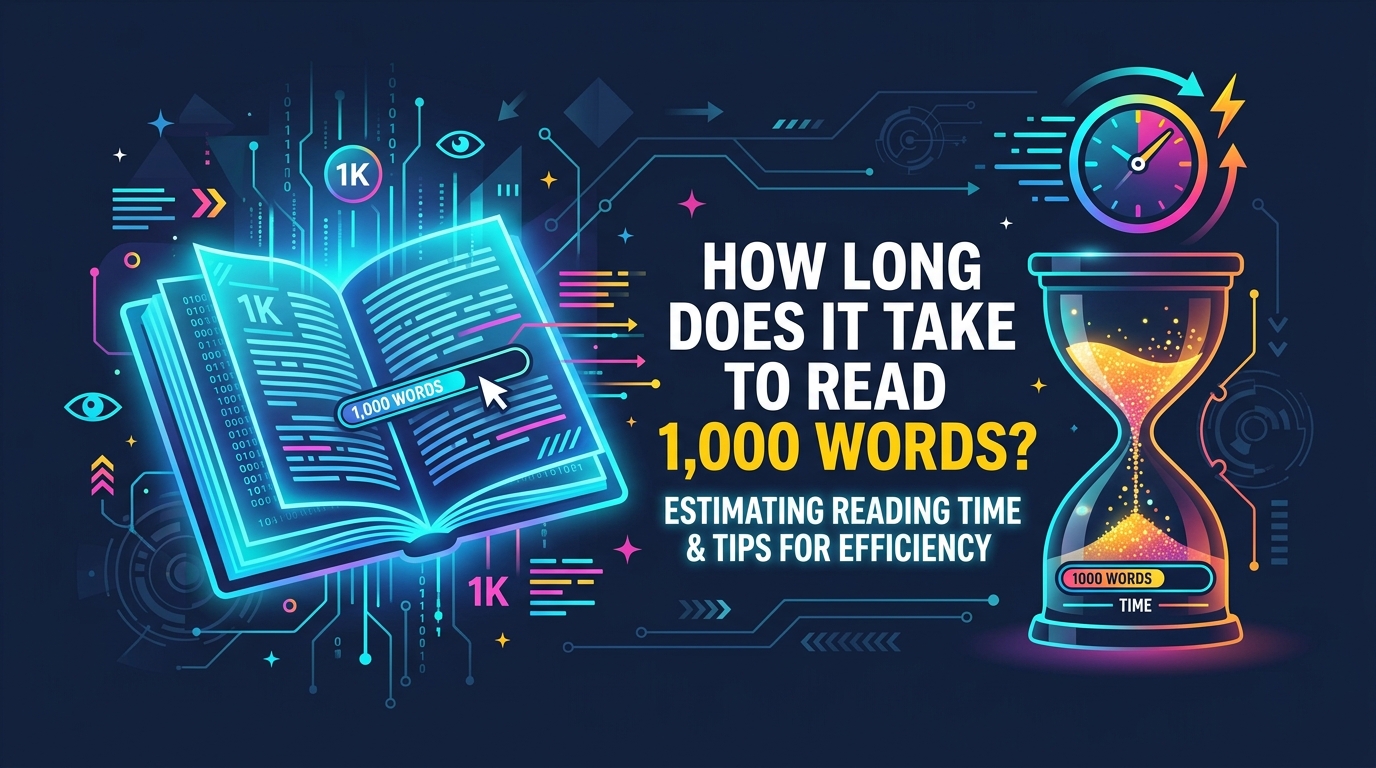
The Quick Answer: About 5 Minutes
The average adult reads at roughly 200 words per minute silently, so 1,000 words takes about 5 minutes. Slower, careful readers (150 WPM) need closer to 6 minutes 40 seconds; faster readers (250 WPM) finish in about 4 minutes.
Reading aloud is a different calculation entirely — speech runs at 130–150 WPM, so reading 1,000 words out loud takes 7 to 8 minutes. That's why a '5-minute read' makes a poor 5-minute speech.
Reading Time by Word Count
At the average 200 WPM silent reading speed:
500 words → 2.5 minutes 1,000 words → 5 minutes 1,500 words → 7.5 minutes 2,000 words → 10 minutes 3,000 words → 15 minutes 5,000 words → 25 minutes 7,500 words → about 38 minutes 10,000 words → about 50 minutes
For context: a typical news article is 600–800 words (3–4 minutes), a substantial blog post 1,500–2,500 words (8–13 minutes), a magazine long-read around 5,000 words (25 minutes), and a novel chapter 3,000–5,000 words (15–25 minutes).
What Changes the Answer: Difficulty, Purpose, and Language
The 200 WPM average assumes familiar material read for general understanding. Dense technical writing, legal text, or academic papers drop most readers to 100–150 WPM, because comprehension — not eye speed — becomes the bottleneck. The same 1,000 words can honestly take 10 minutes if they're from a research paper.
Purpose matters just as much. Skimming for a specific fact runs at 400+ WPM; studying material you'll be tested on runs below 100 WPM with re-reading. And readers working in a second language typically read 30–50% slower than the native-language average, which is worth remembering if your audience is international.
For Writers: Why This Number Is Worth Knowing
If you publish anything, reading time is a promise you make to readers. Displaying an accurate 'X min read' label measurably improves engagement because people are more willing to start an article when they know the commitment — and more likely to finish one that respects its estimate.
The math also works in reverse as a planning tool: writing for a 'quick 3-minute read' means a 600-word budget; briefing a team that a report 'takes 10 minutes' means keeping it near 2,000 words. Consistency is the key — pick one WPM basis (200 is the standard) and use it across everything you publish.
Calculate It for Any Text
For your own articles, essays, or reading assignments, skip the arithmetic: paste the text into a reading time calculator, adjust the speed slider to match your audience — 150 WPM for technical readers, 200 for general audiences, 250 for light content — and you get minutes and seconds instantly.
If you're planning a reading list rather than a single piece, the per-word-count table above is usually all you need: total the word counts, divide by your pace, and block out the time.