From chat window to control room
Two years ago, an "AI agent" mostly meant a chatbot that could browse the web and summarise what it found. That's not what the word means anymore. The agents shipping this year plan a sequence of steps, call other software to carry them out, check the result, and only come back to a person when something falls outside their instructions.
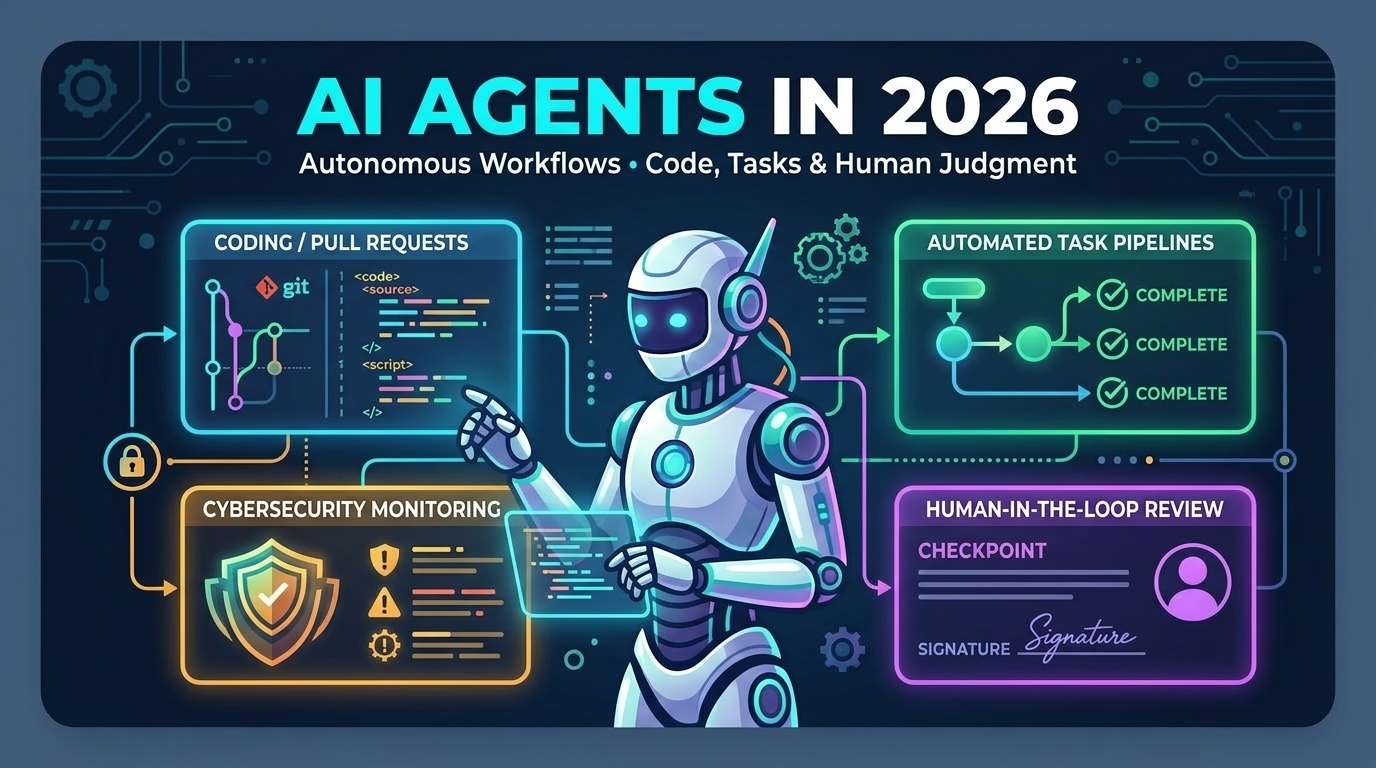
The shift shows up in where the work is actually happening. Coding agents are landing pull requests, not just suggesting them. Support agents are resolving tickets end to end across three or four internal systems, not surfacing a canned reply for someone to approve. Security teams are running "analyst agents" that turn a plain-English question into a full, traceable investigation of a company's logs. None of this is speculative. It's what shipped in the last few weeks.
What they're actually good at right now
The strongest use case, by a wide margin, is still code. One open-source coding agent recently crossed a real milestone: resolving more than two-thirds of the bug reports in a standard software-engineering benchmark on its own, with no human touching the code in between. Meanwhile, GitHub's own coding tools now split a task across several specialised agents: one implements, one writes tests, one documents, rather than asking a single model to do all of it at once.
The second strongest case is anything with a clear start and end state inside a system the agent has real access to: reconciling a payment dispute, routing a ticket through the right internal tools, pulling together a security investigation from raw logs. These aren't creative tasks. They're procedural ones with a right answer that can be checked, and that's exactly the kind of work agents handle well.
Writing is a messier case. Agents are excellent at producing a fast, competent first draft of an email, a report, or a landing page. What they're not good at is knowing when that draft is wrong in a way that matters: a stat that doesn't hold up, a promise the company can't actually keep, a tone that will land badly with one specific reader. That part is still yours.
Where they still fall over
Reliability drops fast once a task needs judgment instead of procedure. Ask an agent to fix a well-specified bug and it usually succeeds. Ask it to decide whether a feature is worth building, or how to word a delicate customer apology, and the success rate falls off a cliff, not because the model got worse but because those tasks don't have a checkable right answer for it to aim at.
The bigger problem in 2026 is access, not accuracy. An agent that can act across several systems is also a new way for something to go wrong across several systems at once, and plenty of companies gave agents that kind of reach before they built the controls to match it. That gap is exactly why a wave of "agent governance" products (tools that just watch what your AI agents are doing and block the risky actions) has shown up this year to sell into it.
A widely cited enterprise survey this year found that large companies running agents in at least one business function jumped from roughly a quarter to two in five within twelve months, while close to a third of organisations skipped buying a piece of software altogether because they could get an agent to build the equivalent internally. Adoption is real and it's fast. Confidence that it's fully under control isn't there yet, and most people running these systems will tell you that directly.
What this actually means if you write, code, or market for a living
The honest version: agents are pushing the cost of a first draft toward zero, and pushing the value of a good editor up. If a tool can generate the code, the copy, or the report in ten seconds, the part of the job that still needs a person is judging whether the output is actually right, on-brand, and safe to put in front of a customer.
That's true whether the "agent" is a formal multi-step system or just you pasting a task into a chat window and iterating on it. Either way, the failure mode is the one writers already know from working with a talented but green contractor: fluent and confident doesn't mean correct. Generated text in particular tends to carry the same handful of tells — filler openers, inflated verbs, a stock set of transitions — regardless of which model produced it, which is exactly why it's worth a dedicated editing pass rather than a quick skim.
A simple check before you publish anything an agent touched
Treat agent output the way an editor treats a stringer's copy: verify the facts, check the numbers, and read it once purely for tone before it goes anywhere near a customer. None of that is a lot of extra work if it's built into the process instead of skipped when you're in a hurry. That's exactly when the mistakes get through.
If the output is text rather than code, run it through an actual editing pass instead of trusting it by eye. The generic phrasing agents default to is easy to miss when you wrote the prompt yourself and already know what you meant to say.