Why AI writing has a vocabulary
Language models pick the most probable next word. Run that process across billions of sentences and the output drifts toward the safest, most average phrasing available — words that appear everywhere in formal English and offend nobody. That is why generated text so often reads competent and forgettable at the same time.
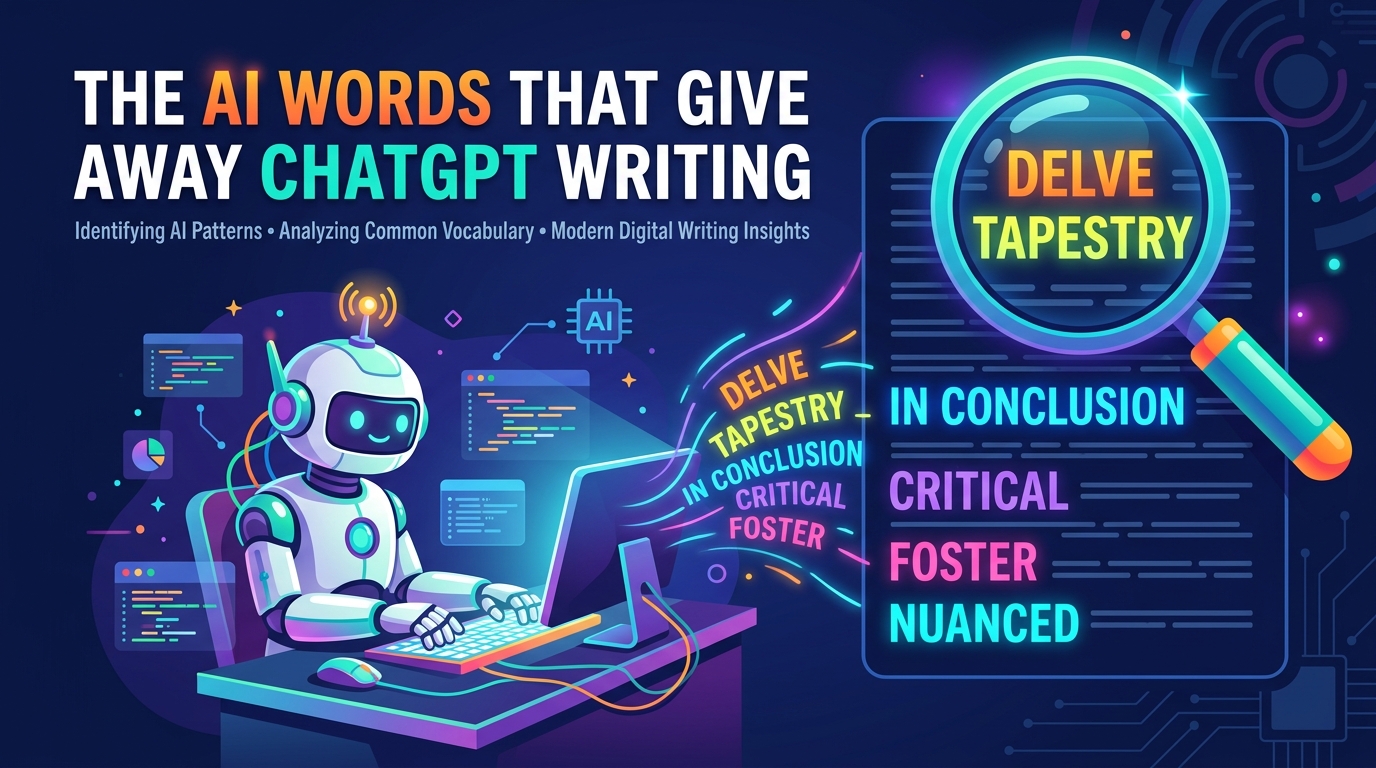
The result is a recognisable vocabulary. Not wrong words, just predictable ones, appearing at rates no human writer would produce naturally. 'Delve' is the famous example: it is a perfectly good verb that models use dozens of times more often than people do.
Readers notice the pattern long before they can name it. A draft feels generic, and the reason is usually vocabulary rather than the ideas underneath.
The verbs
delve into, dive deep into, embark on, harness, leverage, utilise, facilitate, foster, underscore, elevate, revolutionise, unlock, navigate, streamline, empower.
Almost all of these have a shorter, plainer equivalent that reads better. Leverage means use. Utilise means use. Facilitate means help. Underscore means show. Elevate means improve. Harness means use, again.
The pattern is consistent: models reach for the longer Latinate verb where an ordinary English one would do the job. Swapping them back is the single fastest way to make a draft sound like a person wrote it.
The adjectives
seamless, robust, cutting-edge, state-of-the-art, meticulous, comprehensive, intricate, pivotal, paramount, holistic, vibrant, ever-evolving, transformative, unparalleled.
These are marketing adjectives. They assert quality without evidence, which is exactly why they read as filler — 'a robust solution' tells the reader nothing that 'a solution' did not already say.
The test is simple: delete the adjective and see whether the sentence loses meaning. With this list, it almost never does.
The phrases
It's important to note that. It's worth mentioning. Needless to say. It goes without saying. In today's fast-paced world. In the digital age. When it comes to. At the end of the day. In conclusion. That being said.
Every one of these is throat-clearing. They occupy the start of a sentence while the actual point waits behind them. Cutting them loses nothing and typically trims five to ten per cent of a draft's word count.
The stranger ones are worth calling out separately: 'a tapestry of', 'a testament to', 'navigate the complex landscape of', 'unlock the full potential', 'plays a crucial role in', 'a myriad of', 'a plethora of'. These appear in generated text at rates that are genuinely conspicuous.
The connectors
Furthermore. Moreover. Additionally. Nevertheless. Consequently. Firstly, secondly, lastly.
Formal writing uses these occasionally. Models use them to open what feels like every third paragraph, because they are the highest-probability way to signal 'here comes another point'.
Most can simply be deleted — the logical relationship is usually clear from the sentences themselves. Where a connector genuinely helps, 'also', 'but' and 'so' do the same work without the stiffness.
The punctuation tell
Em dashes. Models use them several times a paragraph where most writers manage one or two a page. It has become the most widely recognised signal of generated prose in 2026, to the point where writers who have always liked em dashes now find themselves suspected.
Curly quotes and the single-character ellipsis are milder versions of the same thing. They also cause practical problems: a curly quote pasted into code, JSON or a terminal command will break it, and the error is very hard to spot by eye.
None of this makes the punctuation wrong. It makes it frequent, and frequency is what readers pick up on.
What to do about it
Edit for it deliberately. The list above is finite and the same twenty items account for most of the problem, so a single editing pass catches nearly all of it.
Vary your sentence lengths while you are in there. Uniform rhythm is a stronger signal than any individual word — human writing swings between five-word sentences and thirty-word ones, and generated text tends to settle around the same length throughout.
One thing worth saying plainly: none of this is about defeating AI detectors. Those tools are unreliable in both directions and flag human writing regularly, particularly from non-native English speakers. Edit for the reader, not the detector. Writing that sounds like you is the goal; it happens to be the same work either way.